
Budget and scope
How much should I budget for a bathroom remodel?
Build the budget from your project's variables, not from a national average. The honest sequence is scope first, then a planning range for that scope, then a contingency you commit to not spending on upgrades. A single quoted average answers a different house than yours.
The direct answer
Budget for the written scope you actually intend: which of the room's fixtures change, whether the layout stays, what finish class you will hold, and who does the work. Federal wage data shows remodeling labor rates vary meaningfully by trade and by region, and regional price level data shows the same finished scope carries different totals in different metros, so a useful budget is a range built on your variables plus a contingency of roughly ten to twenty percent held for discovered conditions, not for upgrades.
Anchor the range with the modeled scenario closest to your project on the cost guide, then treat written proposals from professionals who have seen the room as the numbers that replace it. If you cannot yet say which fixtures move and which stay, you are not ready to hold a number, and any number you hold will manage you instead.
The variables that actually move your number
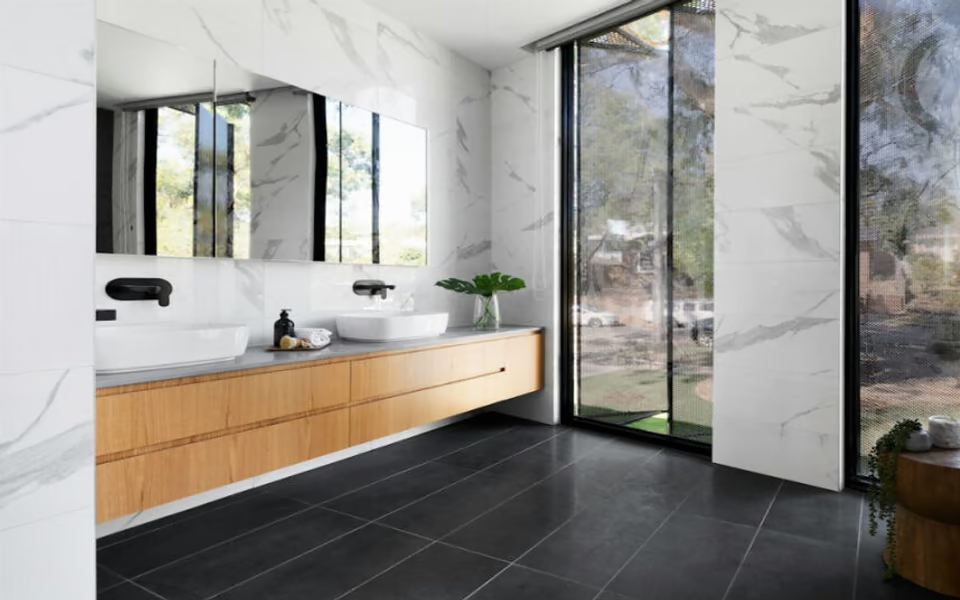
Layout is the structural lever: keeping the toilet, bathing area, and vanity in place avoids rerouted plumbing, added framing, and extra inspection scope that produce no visible finish. Finish class is the visible lever: allowance level on tile, fixtures, vanity, and glass moves both material cost and the labor hours those materials demand. Region is the lever you do not control; published regional price data shows identical scopes landing differently by metro, which is one reason a friend's total elsewhere tells you little.
Household income data is a useful sanity mirror rather than a rule: census tables show wide variation in what homeowners in different areas earn and spend on housing, and a remodel budget that would strain years of household cash flow deserves the phase-split posture, not optimism.
Match the budget posture to the project
Three postures cover most remodels. Pick one deliberately instead of drifting between them mid-project.
| Topic | What it means in practice | What it protects you from |
|---|---|---|
| Scope-first budget | Write the scope, price it with the matching modeled tier, add contingency, and only then decide if the total fits. | The quiet scope growth that turns a refresh into a gut job one upgrade at a time. |
| Ceiling-first budget | Fix the maximum spend, then work backwards to the largest scope that fits inside it with contingency intact. | Falling in love with a project the household cannot comfortably fund. |
| Phase-split budget | Fund the failing zone now to full quality, and schedule the rest as a later phase with its own budget. | Spreading money so thin that every zone gets touched and none gets fixed properly. |
Ask these before trusting any number
- What allowance class does this total assume?
A total without stated allowances for tile, fixtures, vanity, and glass cannot be compared with any other proposal or with your budget range.
- What happens when something is found behind the wall?
The answer should describe documented, priced change orders you approve before work proceeds, which is exactly what your contingency exists to fund.
- Which parts of my scope drive your number most?
A professional who can rank your cost drivers understands your project; one who cannot is pricing a generic bathroom that is not yours.
- What would you cut first to protect the budget?
The order in which a professional would trim scope tells you what they consider structural quality versus optional finish, and that ranking should match yours.
Common questions
Frequently asked questions
Is a percentage of home value a good budget rule?
It is a rough resale-conversation tool, not a planning method. Your scope, your region's labor market, and your household cash flow set what the project should cost you; a percentage of home value answers none of those and quietly imports someone else's assumptions.
How firm should my budget be before talking to professionals?
Firm on the ceiling and the contingency rule, flexible on allocation. Professionals give you their best thinking when the scope is written and the posture is clear, and you keep authority over trade-offs instead of discovering them in a proposal.
Should I share my budget number with bidders?
Share the scope and the allowance classes, and state that a contingency exists without assigning it. That gives every bidder the same problem to price honestly while keeping the discovered-conditions fund from being absorbed into the base bid.
Sources and methodology
Research & methodology
Sources
References supporting the planning guidance on this page.
- American Community Survey Data TablesU.S. Census Bureau
- Occupational Employment and Wage StatisticsU.S. Bureau of Labor Statistics
- Regional Price Parities by State and Metro AreaU.S. Bureau of Economic Analysis
Share your project. Call when ready.
Turn your research into a clear project request
Share your project, full service address, and contact details securely, then call when you are ready to discuss availability with an independent professional.